The Brick House
The Vitality Series, Part I
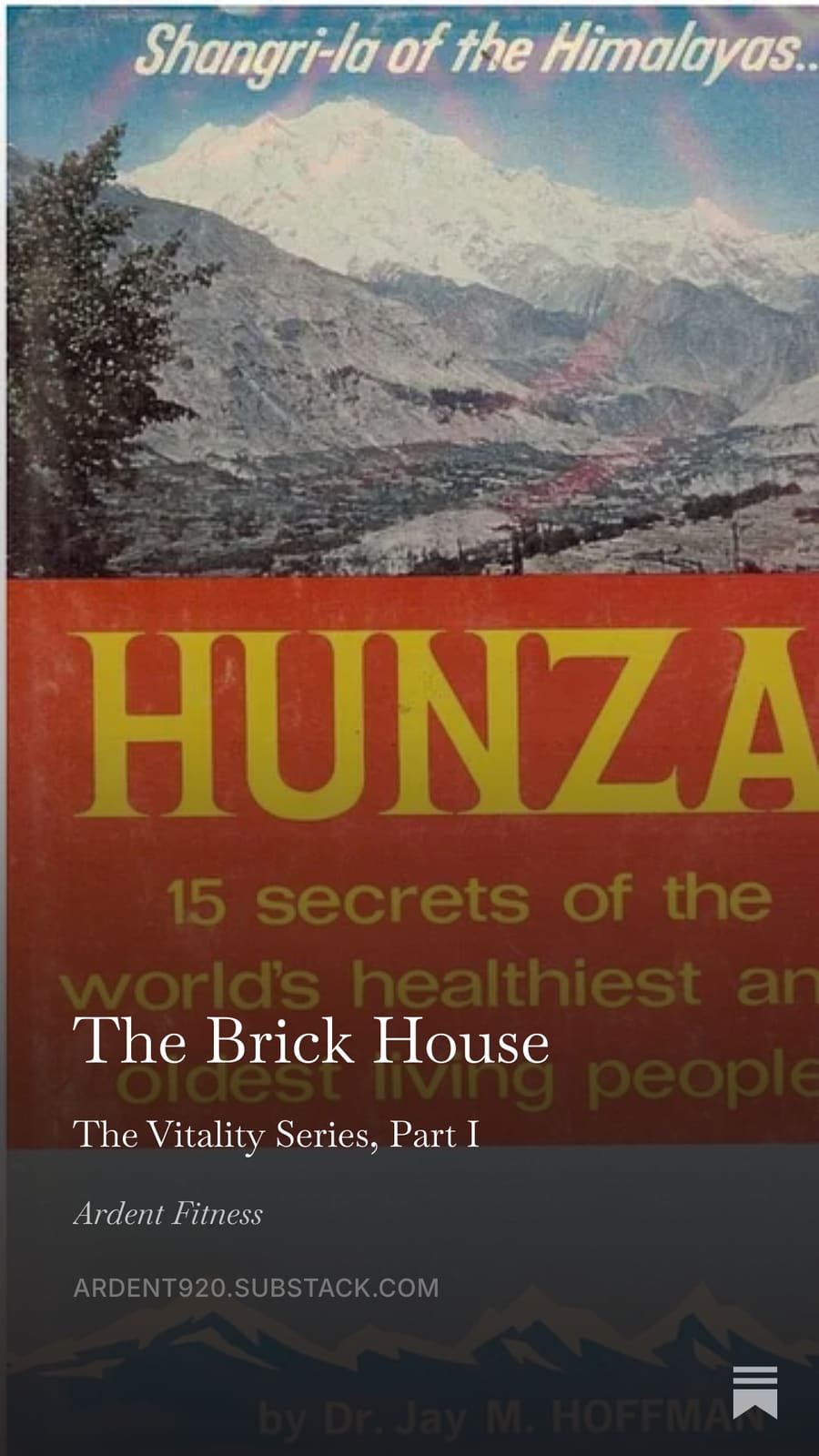
There is a book I recently read from 1968. I picked it up from the free book rack when you enter the Green Bay VA clinic. The cover is beat up, cracked spine, and someone else’s name written on the inside front cover. Jay Hoffman wrote it about the people of Hunza, located in a valley in northern Pakistan where people supposedly lived past 100 and worked in the fields the whole time.
They didn’t have heart disease, or cancer. The last chapter is called “Live to 120.”
After reading the book, it really stretches to make a point. Some of the information is wrong in a way it is actually useful, but only if you take the impact the book is trying to make based on the time it was written.
What the book claims
Hoffman, who has a PhD, takes from Dr. Torben Geill, a Danish gerontologist who claimed anyone can live to 120 years old. Geill claimed death before that point comes from “extrinsic factors” like disease, accident etc. Things which develop from outside the body. If you can control or remove those then what is left is the normal aging of cells.
He gave three rules for people who want a long life:
1. Abide by a healthy diet
2. Walk a lot.
3. Get enough sleep and actually relax.
There is your prescription, free 99, simplified into three bullet points. This guy spent his career as chief physician at a home for old folks in Copenhagen, watched a lot of people wither and die, and boiled it down to these basic rules. I guess you can just keep it simple?
So, if someone builds a house out of brick, he completes it, and he has a brick house. If you build a house of mud, you have a mud house. This is logical and straightforward. Only a true contrarian would argue this, and it would be just to argue.
Now, apply this to your body.
You are shot into this world as a useless sock of meat, a blank slate. Everything you have put into your body through your mouth. The protein, the fat, the minerals have worked through your small intestine and used to build cells and make you who you are today. This is not a metaphor; it is just what happened.
Your body is the house. What you put into your body is the material.
Hoffman pulls on this string by saying, most people care more about what oil goes in their car than what food goes into their stomach. Over half a century later, things have gotten exponentially worse and you could even take it further. More people care about the food which goes into their pets than they do about the food they are consuming.
The problem with the premise
You can’t look at a book from the mid 1900s, in a field which is subject to the scientific method, and claim what is being said is evidence.
When you are born or were born in the Hunza Valley, you were not issued a birth certificate. Age came from oral tradition and self-reporting where being older meant more respect.
An American geologist, John Clark, lived with the Hunza for twenty months in the early 1950s. He ran a medical dispensary out of his home and treated the local population the entire time. It was not a valley free of disease-free centenarians; it was more like a valley of people who needed care but lacked access to it.
When I was in the Kunar Province of Afghanistan around 2011, mountain villages were isolated. Most individuals were born, lived, and died within the same few square miles. The austere and non-permissive environment did not allow for easy access to health care. This doesn’t mean the individuals were disease free or extremely healthy. They were plagued with a lot of the same issues, and some not-so same issues, individuals from more industrialized areas of the world. It is just not documented as well.
Saul Newman’s demographic work found that regions producing the most extreme old-age records tend to keep the worst birth records while having some of the shortest life expectancy. His paper is still in preprint, not peer-reviewed, so take it for what it is worth.
There are some other reasoning holes the book has which I want to mention so you can sit in awe about how far we have truly come since the mid 1900s. Dr. Edward L. Bortz, former president of the American Medical Association, is cited arguing humans should live to 150 because a dog matures at two and lives to twelve years. While it wasn’t stated as biological law, using it as a comparative observation still disregards how biology works. Trust me, I took Bio 101 twice! The book also extrapolates a 140-year human lifespan within two or three generations based on rodent calorie restriction. You can take that for what it is worth, but right now our lifespans seem to be going the other direction.
This book also has a section on apricot pits curing cancer…I am just leaving that alone. I am pretty sure this was about the same time they were telling women to smoke cigarettes to lower the birth weight of babies.
What is true
When you let go of the bad math and mysticism, you are left with four key takeaways.
Eat well, move, sleep, and try not to get sick. Earth shattering, right?
60 years of science has not overturned a single one of these. Cardiorespiratory fitness (CRF) tracks with all-cause mortality as something we can actually change. In one of the largest studies of its kind, the survival difference between the fittest and least fit was larger than the risk associated with smoking, coronary artery disease, and diabetes. (Mandsager, K., 2018)
Interestingly enough, muscle works the same way. I like to call building muscle an investment, just like your 401k. What you build in your forties is what you will be drawing from in your 70’s. Being strong isn’t vanity, being strong is an investment you will be drawing from as you age. You have probable heard my quote Mark Rippetoe in the past, and I am going to do it again:
” Strong people are harder to kill than weak people and more useful in general.”
-Mark Rippetoe
Sleep is something many of us could improve. Contemporary society seems to try steal sleep from us through technology, optimization, and highlighting “the grind.” Something simple you can do, it doesn’t cost you any money, is focus on getting at least seven hours of sleep a night. This conversation is more than a paragraph in a blog post, but I want you to understand, you don’t get stronger in the gym. You get stronger in bed, recovering.
While Geill’s numbers weren’t right, his framing was. What kills people early comes from how thy live, we do not have a predetermined expiration date stamped on us at birth. There is actually a name, thanks science, for what Geill’s was getting at. Compression of morbidity. Essentially, postponing the onset of chronic illness and disability to maximize the years of healthy living. This is where you use the tools available (exercise, healthy diet, sleep etc.) to delay functional decline and have as many healthy years as possible.
We do not have a choice; we will all die. What we do have a choice in is how we live those years leading up to our death.
Where we tend stumble
Alot of people treat training and nutrition as two different projects, I know I did when I was younger. Someone will grind through a new training regimen but eat like a trash panda and wonder why they are not seeing progress. Or they will work some abhorrent calorie deficit with no training and lose weight but half of it is muscle. Then they wonder why they feel worse at a lighter bodyweight and quit.
This is not failure; it is the lack of a system. Training is the signal which tells your body what to build, food is the material used to do the building.
This is why Vitality (exercise and nutrition) is the north arrow or compass rose of Ardent. These are two things, which can work on their own to a point, but when put together can change your life, help you live your best life, and spend more time living.
Where we are going
I took a few weeks off of writing to work on some systems changes in the gym, but we are back! Part II we are going to get into what your body is running on and what feeds it. For now, I want you to sit with the mud house analogy. You are, in the most literal sense possible, built out of what you eat and shaped by what you ask your body to do. A mid 1900’s book full of nonsense got that part right, because you do not need a peer reviewed study to know a house made of mud is a mud house.
Get Stronger. Live Longer
Sources
Hoffman, Jay M. Hunza: Secret of the World’s Healthiest and Oldest Living People. 1968. Chapter 37, “Live To 120.”
Clark, John. Hunza: Lost Kingdom of the Himalayas. Funk & Wagnalls, 1956.
Newman, S.J. “Supercentenarian and remarkable age records exhibit patterns indicative of clerical errors and pension fraud.” bioRxiv. doi:10.1101/704080. Preprint, not peer reviewed.
Mandsager, K., et al. “Association of Cardiorespiratory Fitness With Long-term Mortality Among Adults Undergoing Exercise Treadmill Testing.” JAMA Network Open. 2018;1(6):e183605. doi:10.1001/jamanetworkopen.2018.3605
Fries, J.F. “Aging, natural death, and the compression of morbidity.” New England Journal of Medicine. 1980;303(3):130-135. doi:10.1056/NEJM198007173030304