Note: Same as the last, this is not medical advice. I am a coach, and while I have more graduate credits than most doctors, a doctor I am not. We are still going to take broad strokes so this is accessible to more people and everyone can have a better idea of what is actually happening in their bodies over time.
In Part I, I talked about a book from the mid-20th century that promised 120 years of life. In Part II, we spoke about nutrition and the three systems your body uses to make energy and how to fuel those systems.
In the end, yes, finally, we will be talking about something which matters more than how long you live: how long you work. Not the type of work you do to make enough money to survive, but how long you actually work. You, your body, your ability to live your best life.
The number we leave out
According to the World Population Review the average life expectancy in the United States is 78.5 years. By state, Hawaii holds the highest of 81.11 years, and Mississippi has the lowest at 73.89. According to this review, Wisconsin has an average life expectancy of 79.04 years. Interestingly enough, women outlive men in every single state.
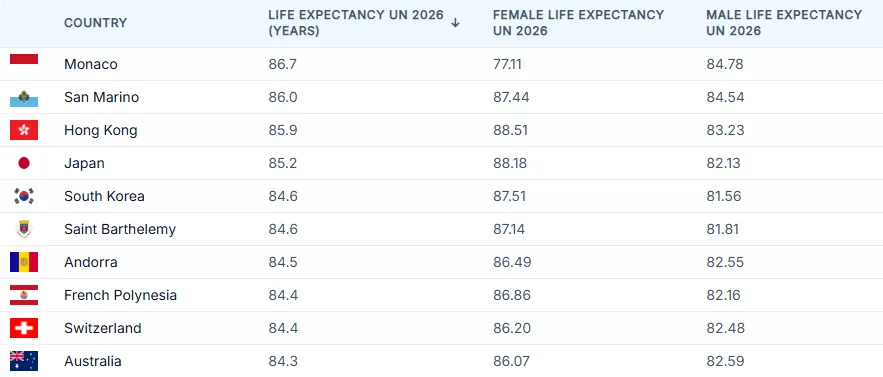
Just for your situational awareness, when you put the US against the world in Life expectancy, we sit tied with the Falkland Islands and just above Estonia. I wanted to include a list of the top ten countries, so you could see where the United States ranks according to theWorld Bank Group.
The number we really want to focus on is our health-adjusted life expectancy. This number translates to the number of years you can expect to live without significant disability. That number for the US is about 66 years. So, the healthspan-lifespan gap in the US is a bit over 12 years, which is the largest gap in the world. These numbers come from a 2024 study out of Mayo which looked at 183 countries (Garmany & Terzic, 2024).
This is not a good thing. The average American spends the last twelve years of life sick, disabled, or dependent on someone else to get through their day. I am sure you have seen this happen. The parent or grandparent who gets sick, can’t fully recover, and goes from independent to dependent. This is why I think we need to change the conversation from life expectancy to health-adjusted life expectancy.
We chase the wrong number
Every longevity conversation is about how long someone wants to live, but we fail to grasp that the condition a person is living in matters. Earlier in the Vitality Series, we brought up compression of morbidity, an idea from a 1980 paper by a physician named James Fries (Fries, 1980). This simple idea is acknowledging that the end is coming, regardless, and the goal we should be focusing on is pushing sickness and disability into the smallest possible window. Don’t just chase more years. Chase more good years, and less time at the end in sickness and disability.
Twelve years is not a short amount of objective time to live in sickness. Looking back, it will feel short, since you’re not living your life anymore but just existing.
The Danish doctor from the first post in this series, Geill, was wrong about the numbers, but he was right about an overarching theme. It is not a predetermined expiration date which dictates a life, but how a person lives their life. Not the deep philosophical way of thinking about one’s life, but how they move their body and what they put into their body.
What goes first
When looking at aging, a lot of people may think you’re here, and then you have one bad day, your heart goes, and you are gone.
That is not the norm.
What we actually start losing is muscle mass, and it starts somewhere in your thirties and really picks up the pace after 50. For a while it doesn’t matter, you have enough where nothing really feels different. Maybe you’re a bit slower to recover, maybe your grip strength drops a bit, but all in all you can keep living life as usual, until you can’t.
You have a tough time getting off the ground, you can’t get out of a chair without using your arms, you need to take the elevator because you are winded, and the list goes on. Your world starts to shrink a little bit at a time, but nothing feels like a crisis because it is slow.
And then you fall.
That fall is what changes everything. Not the actual fall, but everything after the fall. Maybe you broke a hip and spent weeks laid up. In those weeks you lose more muscle after quietly leaking muscle for decades, and your independence disappears with one slip or misstep.
The process is slow, until it isn’t.
What can predict it
We have measurements which can help predict how the back end of your life could go. They do not usually get measured in your annual physical, but the good news is you can train every one of these predictors.
The first one is grip strength. According to a study in 2015, it was a stronger predictor of death than systolic blood pressure. Every 5 kg drop in grip strength was associated with a 16 percent increase in all-cause mortality (Leong et al., 2015). This is an easy one to train. Just Google “grip strength trainer,” order one, and start squeezing.
The second one I want to point out is walking, and not just the act of walking but how fast you are walking. An analysis found gait speed predicted survival across a spectrum of speeds. At 75, predicted 10-year survival ran 19 to 87 percent in men, depending largely on how fast they walked (Studenski et al., 2011). Go outside, or get on a treadmill, and start walking. If you are outside and there are telephone poles, increase your walking speed between every third and fourth pole. No gym membership, no money needed.
The last one is aerobic capacity, which we talked about in the first part of this series. If you remember, the survival difference between the most fit and the least fit was larger than the risk carried by smoking, diabetes, or coronary artery disease (Mandsager et al., 2018). Again, something which can be easily trained or added to your life.
This is not an all-inclusive list, but you could make a huge difference in your healthspan without adding a gene test, supplement, or prescription. These are things you can start improving this week, even today, at any age, without buying a gym membership, taking a crazy supplement, or going to a medical professional. Think of this as your low barrier to entry to extending your healthy years of life.
Back to Hunza
I wanted to bring all of this back to the 1968 book which started this series. The 120-year claim was never real, but that does not mean there wasn’t something there. Disregarding the exaggerated lifespan, I think we can pull from the health-adjusted life expectancy story.
Even without much information, I can tell you they didn’t have a 12-year gap between life expectancy and health-adjusted life expectancy. The elders were still active, and Hoffman made a case for apricots, but I think it had little to do with what they were eating. They stayed in motion. The people of this valley used their capacity every single day until they couldn’t. This means they kept their capacity longer, and there was not a decade of slow decline in a recliner.
In 2026, we arguably have better medicine, better food (if you choose to eat it), and better sanitation than that valley ever had. We should be outliving them by a wide margin, but right now we are set to spend the last twelve years of our lives not being able to do our own grocery shopping or clean ourselves.
They are not healthier than us. They manage to stay useful longer because they continue to use their bodies as they age.
What we do
I have sat down and spoken with hundreds, if not thousands, of people over the last 15 years about their wellness. A lot of the stories have common threads. Grew up playing sports and being active. Now they have been sedentary for the last 10, 20, 30+ years. Life happened. Kids, grandkids, work, and everything which marks our contemporary existence. We also have these lives of convenience, technology, and everything we want a few clicks away on our phones. I do have some conversations which stick out because they spoke directly to the idea of Vitality and what we have been talking about.
A client spent the last 40 years working hard to retire early and spend their golden years traveling with their partner. Going to all of the places they put off going in their youth due to responsibilities and work schedules. Except when they finally retired, they found themselves on the wrong end of the health spectrum, and these trips, which were out of reach for life obligation reasons, became out of reach due to health reasons. We were able to get them back to a place where travel was feasible, bring them back from the brink of type 2 diabetes, and increase their health-adjusted life expectancy. This is why we are not just a weight loss gym.
Weight loss is a fine goal, something people want, and we can help you with that. I am not here to lecture someone about their goals. If it motivates you, that is all that matters. What I do want you to consider is that there are better organizing principles for a life. The number on the scale doesn’t dictate whether you will be climbing your own stairs at 79 years old.
The deadlift is not about the deadlift. It is about picking something up off the ground, which you will be doing for the rest of your life, whether you train for it or not. What we are really training for is a Tuesday forty years from now when you need to get a suitcase into an overhead bin and you do it on your own. What we are training for is to be viable and self-sufficient as we age, to have experiences with our kids and grandchildren. To take that trip we have been working toward for the last forty years.
In Part I, I quoted Rippetoe. “Strong people are harder to kill than weak people and more useful in general.” It is easy to remember the first half of that line, but the second part is more important. More useful in general. That is what we train. That is who we are. We are here to help you live your best life, today, tomorrow, and 40 years from now when this gym is long gone.
You are going to die. Sorry. That is just a fact.
What is yet to be decided is how many of the years before that moment you will spend able to do all the things you actually want to do.
Get Stronger. Live Longer.
Sources
Fries, J. F. (1980). Aging, natural death, and the compression of morbidity. New England Journal of Medicine, 303(3), 130-135.https://doi.org/10.1056/NEJM198007173030304
Garmany, A., & Terzic, A. (2024). Global healthspan-lifespan gaps among 183 World Health Organization member states. JAMA Network Open, 7(12), e2450241.https://doi.org/10.1001/jamanetworkopen.2024.50241
Leong, D. P., Teo, K. K., Rangarajan, S., et al. (2015). Prognostic value of grip strength: Findings from the Prospective Urban Rural Epidemiology (PURE) study. The Lancet, 386(9990), 266-273.https://doi.org/10.1016/S0140-6736(14)62000-6
Mandsager, K., Harb, S., Cremer, P., Phelan, D., Nissen, S. E., & Jaber, W. (2018). Association of cardiorespiratory fitness with long-term mortality among adults undergoing exercise treadmill testing. JAMA Network Open, 1(6), e183605.https://doi.org/10.1001/jamanetworkopen.2018.3605
Studenski, S., Perera, S., Patel, K., et al. (2011). Gait speed and survival in older adults. JAMA, 305(1), 50-58.https://doi.org/10.1001/jama.2010.1923