Austin Phillips, Founder of Ardent Fitness and Education
•
January 28, 2026
Friction Is Not the Enemy
Why Making Life Slightly Harder May Be the Most Effective Form of Self-Care
For the last decade, we have been taught a simple story: Friction is bad. Convenience is good. Faster is better.
This story shows up everywhere. One-click ordering. Infinite scroll. Food delivered to your door. Work that follows you home. Entertainment that never ends.
But here’s the problem.
When friction disappears entirely, choice disappears with it.
This is not a moral argument. It’s an ecological one.
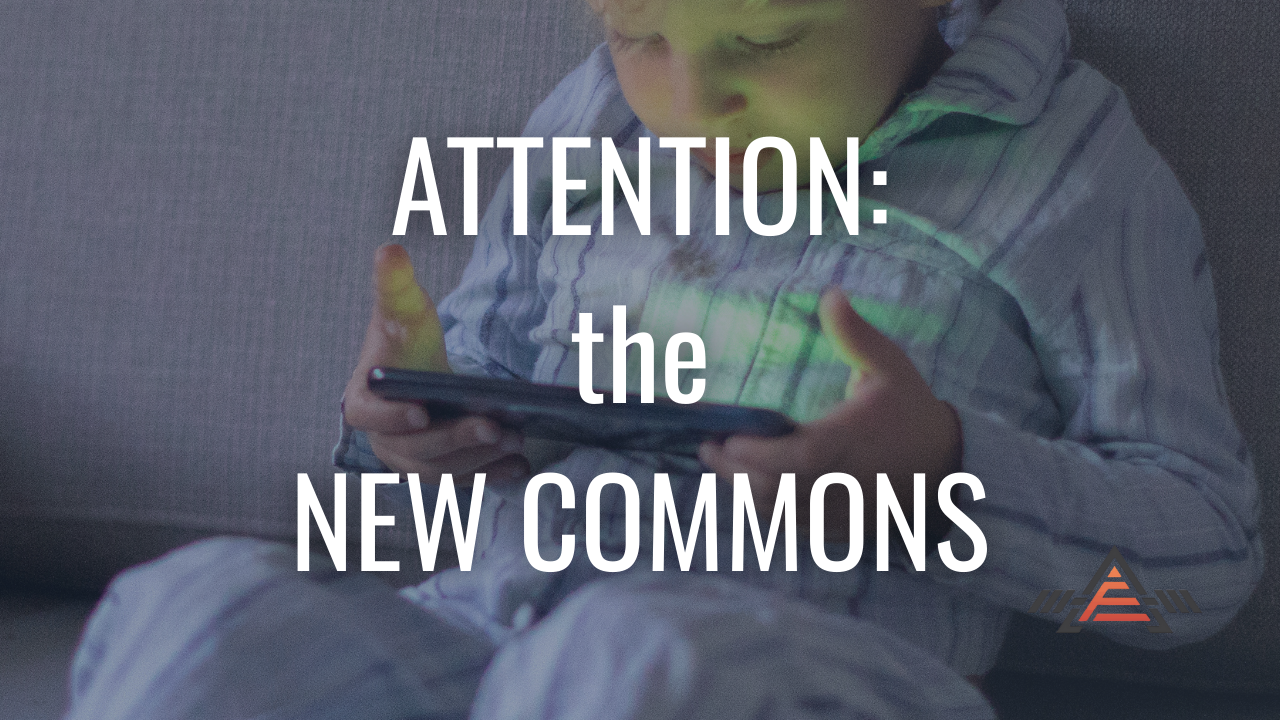
In our last post, Attention Is the New Commons, we explored how attention has become a shared resource that is quietly over-extracted. Platforms, products, and systems are designed to reduce friction to zero because friction slows consumption. Slowing consumption is bad for growth models.
But what is good for extraction is often bad for humans.
This post argues something counterintuitive but deeply old:
Friction is not a hindrance to a good life. It is one of the conditions that makes a good life possible.
Friction as an Ancient Idea
Long before smartphones or social media, humans understood something we have forgotten: Not everything that can be accessed easily should be accessed constantly.
Rituals existed to slow transitions. Rules existed to limit indulgence. Boundaries existed to protect meaning.
Anthropologists have long noted that important domains of life were deliberately harder to enter:
Sacred spaces required preparation
Hunting required effort, skill, and patience
Feasts were periodic, not constant
Rest was structured, not accidental
These were not inefficiencies. They were design features.
Friction created separation between:
The ordinary and the meaningful
Impulse and intention
Consumption and participation
Modern life has erased most of these separations.
The Modern Problem: Zero-Friction Living
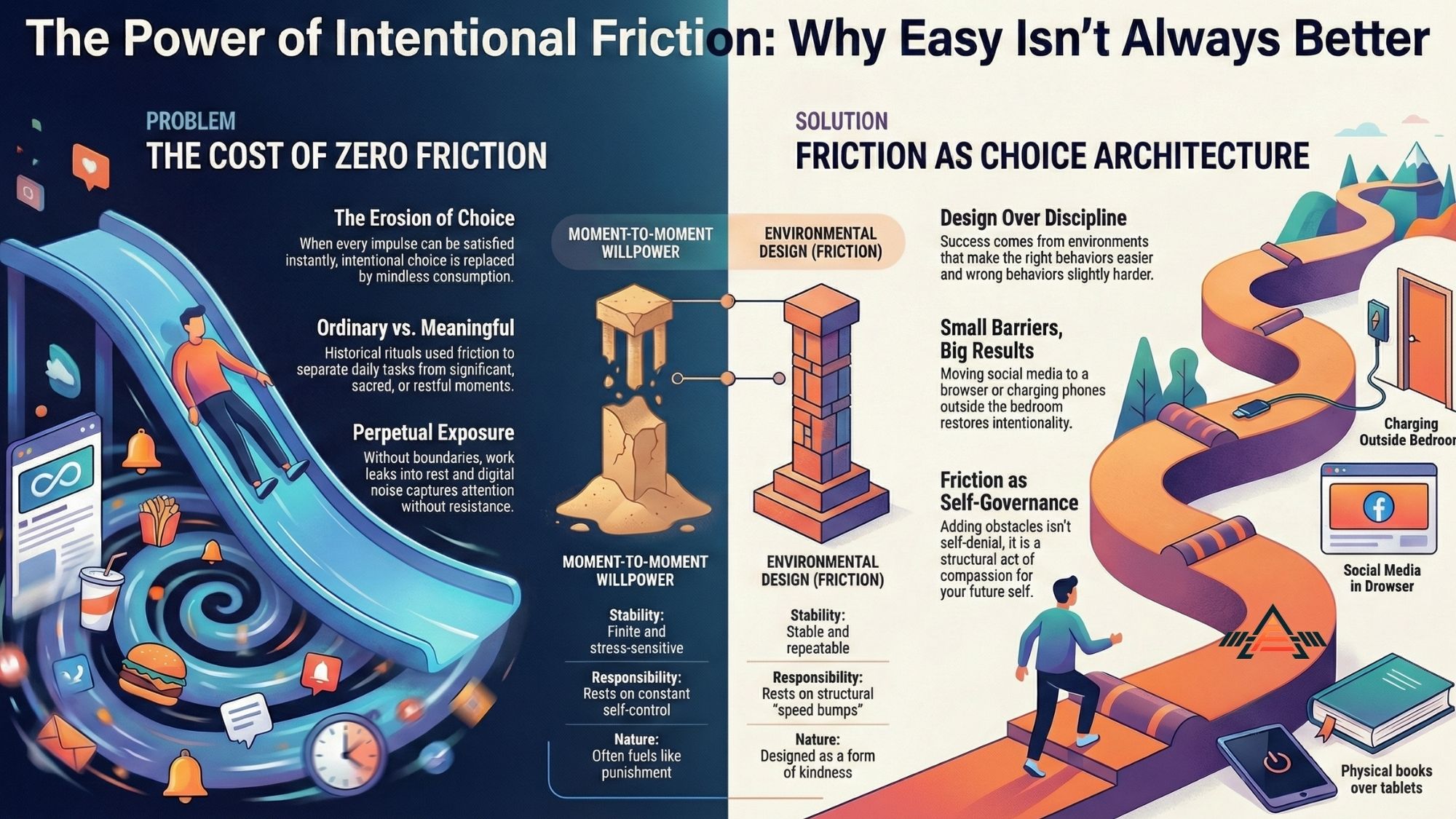
The Problem and Solution
Today, friction has been engineered out of daily life with remarkable precision.
Your phone:
Is always within reach
Requires no effort to unlock
Delivers infinite novelty
Never asks what you intended to do
Food:
Is always available
Requires minimal preparation
Is engineered for hyper-palatability
Work:
Has no clear beginning or end
Leaks into rest
Is optimized for responsiveness, not depth
The result is not freedom. It is perpetual exposure.
When everything is easy, nothing is chosen.
Friction as Choice Architecture
Behavioral economists use the term choice architecture to describe how environments shape decisions.
Here’s the key insight:
Small barriers disproportionately reduce impulsive behavior while leaving intentional behavior intact.
This is why:
Putting social media on a browser instead of your phone dramatically reduces use
Keeping snacks out of sight reduces mindless eating
Scheduling workouts increases follow-through
Charging your phone outside the bedroom improves sleep
Nothing is forbidden. Nothing is deleted. Access remains. But access now requires intent.
Friction doesn’t remove freedom. It filters noise from signal.
Friction vs Discipline (A Critical Shift)
We have been sold the idea that success comes from discipline, grit, and willpower.
But decades of research show something different:
People who appear “disciplined” usually just live in environments that make the right behaviors easier and the wrong behaviors slightly harder.
Friction moves responsibility from moment-to-moment self-control to environmental design.
This matters because willpower is:
Finite
Stress-sensitive
Unequally distributed
Design is:
Stable
Repeatable
Kind
Friction is not punishment. It is compassion at the structural level.
Attention, Agency, and Moral Ecology
When friction disappears entirely, attention becomes easy to capture and hard to defend.
This is why friction has ethical weight.
If attention is a commons, then friction is the fence, the speed limit, the seasonal rule that prevents overuse.
Adding friction is not self-denial. It is self-governance.
It is saying:
“Not everything gets instant access to me.”
“Some things deserve effort.”
“My future self gets a vote.”
Friction as Identity Alignment
There is one final layer that matters deeply.
Friction is a way of aligning who you say you are with how your environment behaves.
If you value:
Health
Presence
Depth
Craft
Community
But your environment rewards:
Speed
Distraction
Constant novelty
You will feel internal tension.
Friction resolves that tension quietly. No affirmations required.
The Point
This is not about becoming more extreme. It is about becoming more intentional.
You don’t need to delete everything. You don’t need to live like a monk. You don’t need more rules.
You need a few well-placed speed bumps.
Action you can take right now to improve your life: Delete social media apps from your phone. You do not need to delete your profile, just the apps.
Add friction into your life to live a better life.
A Thoughtful Next Step
If this made you pause, that matters.
Most people don’t need more information. They need space to think and someone to help them apply it.
A No Sweat Intro is a calm, no-pressure conversation where we look at your goals, your current routines, and where a few small changes in design could make everything feel easier.
No workout. No sales pitch. Just clarity and a plan.
.jpg)

.jpg)
.jpg)
.jpg)

.jpg)
.jpg)
.jpg)
.jpg)

.jpg)
.png)
.jpg)
.png)
%20(1).jpg)
.png)
.png)


.png)
.png)


.png)


%20(Instagram%20Post).png)
.jpg)


.png)

.png)