Every January, the fitness industry lights up. Ads get louder. Gyms run promotions. Social media fills with transformation promises and "new year, new you" energy.
And every February, most of it is already gone.
Not because people are lazy. Not because they lack discipline. Because January was never the right time to rebuild.
It is, however, the right time to start paying attention.
January Is Miscast
January is not a bad month. It just gets asked to do a job it was never built for.
Think about what January actually looks like. The days are short. Sleep is off. Routines from the holidays are still unwinding. Stress from work, finances, and family is running high. Energy is low. The weather limits movement and social connection.
And yet, this is when the entire culture tells people to overhaul their lives.
When that inevitably falls apart, we turn the blame inward. We call it a motivation problem. A discipline problem. A willpower problem.
It was never any of those things. It was a timing problem.
January is for orientation. Spring is for expansion.
Austin Phillips
What January Is Actually Good For
January invites reflection. That instinct is real and worth honoring. The turn of the year naturally asks us to look at what happened, what worked, what didn't, and what we want to feel different going forward.
Those are good questions. They are just not action questions. They are design questions.
January is the right time to notice patterns without punishing them. To sit with what carried over from last year and decide what still belongs. To get honest about what you have been forcing versus what actually fits your life.
That process matters. It is the difference between starting another program and starting the right one.
Why Spring Is When Change Actually Sticks
If you look honestly at when people sustain real change, it is rarely January.
Spring brings longer days. Sleep improves. Energy picks up. Movement gets easier because you are not fighting the weather to do it. Social rhythms come back. The environment starts helping instead of resisting.
That matters more than motivation ever will.
Humans did not evolve to overhaul themselves in the cold and dark. We evolved to recover there. Winter was for preservation and rest. Spring was for building, expanding, and moving forward.
Change sticks when the environment supports it. Spring does that naturally. You do not need to white-knuckle your way through the hardest conditions of the year to prove you are serious. You need to be smart about when you go all in.
Change sticks when the environment supports it. Spring does that naturally.
Austin Phillips
Respecting the Seasons Instead of Fighting Them
Winter is for simplifying. Stabilizing sleep. Reducing friction. Rebuilding trust with your body after a hard year. Letting go of expectations that were never realistic to begin with.
Spring is for adding load. Increasing volume. Expanding goals. Building capacity and chasing real momentum.
When we flip those seasons, people burn out. They sprint through January on fumes and quit by March. When we respect the natural rhythm, people last. They build slowly, and when conditions improve, they have something real to accelerate.
This is not about waiting for the perfect moment. There is no perfect moment. It is about being honest with yourself about what kind of effort is sustainable right now and what kind of support you need to keep going when the initial energy fades.
You Are Not Behind
If you are reading this and thinking about your health, you are not late. You are not behind. You are paying attention, and that is the part most people skip entirely.
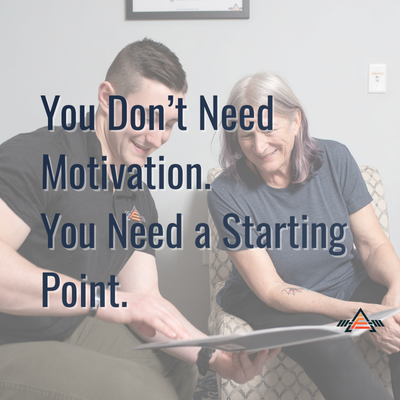
You do not need to force a dramatic reset. You need clarity. You need honesty about where you are. And you need a plan that fits the reality of your life, not the pressure of a calendar or an Instagram ad.
The question was never whether you are motivated enough. The question is whether you are willing to use this moment to figure out what you actually need next.
You do not need to force a dramatic reset. You need clarity. You need honesty about where you are.
Austin Phillips
January is for orientation. Spring is for action. And if you use one well, the other takes care of itself.
If you can walk through the door, we got you from there.
Ready to Stop Starting Over?
Book a free No Sweat Intro. No pressure. No workout. Just a conversation about where you are and where you want to go.
Book Your No Sweat Intro
.png)




.jpg)
.jpg)
.jpg)
.jpg)

.jpg)

.jpg)
.jpg)
.jpg)

.jpg)
.png)
.jpg)
.png)
%20(1).jpg)
.jpg)

.png)




.png)
.png)


.png)


%20(Instagram%20Post).png)
.jpg)


.png)

.png)