How to Build a System That Actually Keeps You Lean | Ardent Fitness
Understanding fat loss is not enough. Here is what it actually takes to build a system around your real life, and why the process is not the obstacle. It is the point.
By
Austin Phillips
March 22, 2026
Don’t miss another article
Thank you! Your submission has been received!
Oops! Something went wrong while submitting the form.
I want to tell you something that took me a long time to understand.
The process is not the obstacle.
The process is the point.
That sounds simple. It might even sound obvious. But the entire weight loss industry is built on the opposite premise. That the process is something to be shortened, optimized, or bypassed entirely in favor of getting you to the result as fast as possible.
And it has worked beautifully, as a business model.
As a health strategy, it has been a disaster.
The Witch's Kitchen
Goethe wrote about this problem two hundred years ago in Faust.
There is a scene in the play where Faust, desperate to feel young and vital again, visits a witch's kitchen.
She brews him a potion. He drinks it.
And instantly, without effort, without change, without any of the hard internal work that actual transformation requires, he feels young again.
He got the outcome. He earned nothing.
The fitness industry has been selling that potion for fifty years. A different label every decade.
The cabbage soup diet.
The fat burner.
The cleanse.
The waist trainer.
The appetite suppressant.
The thirty-day fix.
The result, handed to you externally, with no requirement that you become anything different in the process of getting it.
And just like Faust, the people who drink it end up exactly where they started the moment it runs out. Because nothing inside them changed. No new skills. No new identity. No system that survives contact with real life. Just the temporary appearance of the outcome, with no foundation underneath it.
That is what this blog is about.
Not another potion.
Not a faster path.
A real one.
A note: this series is not about medical weight loss, GLP-1 medications, or any supervised clinical approach. Those conversations belong with your doctor. This is about building a behavioral system that holds up in real life.
Why Knowing Is Not the Same as Doing
If information were enough, nobody who understood nutrition would be overweight.
We live in the most information-rich environment in human history. You can find a credible explanation of fat loss physiology in thirty seconds. You can download a meal plan, a workout program, a habit tracker, a macro calculator.
All of it is available, most of it is free, and none of it is the missing piece.
The gap between knowing and doing is not an information gap.
It is a systems gap.
A system is not a plan. A plan tells you what to do. A system is the structure around you that makes doing it the natural, low-friction path rather than the one that requires constant conscious effort.
Most people try to execute a plan inside a life that was never designed to support it. They are swimming upstream every single day. They are relying on willpower in an environment that is actively working against them. And they are doing all of it alone.
That is not a character failure.
That is a systems failure.
And it is exactly what the first hundred days at Ardent are designed to solve.
What the First 100 Days Actually Look Like
The first hundred days are not about transformation.
They are about foundation.
Most programs front-load intensity. They hit you hard in week one, assume motivation will carry you through, and watch the dropout rate climb by week three.
That is not a program design problem. That is a behavior change problem.
Motivation is a poor fuel source. It is high-octane and it burns fast.
What we build in the first hundred days is something different.
We build a baseline.
The goal in the first hundred days is not to see how much you can change. It is to find the floor you can always return to, no matter what life throws at you.
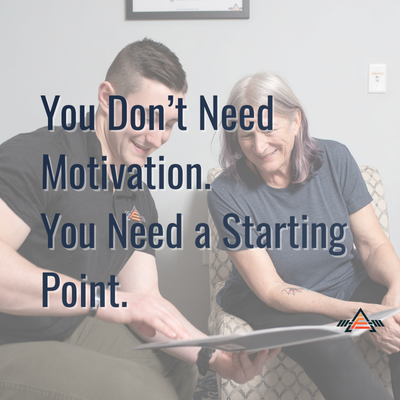
It starts with a conversation. Not a workout. A real sit-down where we ask about your life, your schedule, your history, your stress load, what you've tried before and why it stopped working. We call it the No Sweat Intro and it is the most important hour of the whole process, because it is the hour where we stop guessing and start building something that actually fits.
From there, the first weeks are about posture, positioning, and movement patterns. Not because we are being easy on you. Because a body that moves well is a body that can train consistently for years. We are not building a six-week result. We are building a practice.
Alongside the movement, we track. An InBody scan gives us a real picture of body composition, not just the number on a scale. We set goals that are specific to your biology, your life, and your timeline. Not someone else's.
Around week four, we do a goal review. Not to grade you. To adjust. Because the plan that made sense in week one rarely looks exactly the same in week four, and a system that cannot adapt is not a system. It is a program with an expiration date.
By day one hundred, something has shifted. Not just in the body. In the identity. You are no longer someone trying to get healthy. You are someone who trains. Someone who shows up. Someone who has a floor they know they can stand on even when everything else is hard.
That identity shift is the whole game. Because identity-based behavior is self-sustaining in a way that goal-based behavior never is. You do not have to motivate yourself to be who you already are.
You Cannot Build a System in a Vacuum
We said it in Part 2 and it is worth saying again here.
You cannot consistently outperform your environment.
The research on behavior change is clear on this. The people who sustain healthy behavior long-term are not the ones with the most willpower. They are the ones who built their life around making healthy behavior the easiest available option.
That means your environment has to change. Not just your habits.
At Ardent, the environment is part of the offering. Not as a nice-to-have. As an active ingredient. Coaches who know your name and your history. Members who have been exactly where you are. A culture that normalizes showing up even when it is hard and coming back after you've been gone without shame or explanation required.
That environment does not happen by accident. It is built intentionally, over twelve years, because we understood early that the program was never going to be the differentiator.
The people and the culture around the program would be.
When your environment expects you to show up, you show up. When your environment catches you when you fall, you get back up faster. When your environment is oriented toward the same direction you are trying to go, you stop swimming upstream.
The system is not just what you do. It is the people around you while you do it.
If You Can Walk Through the Door
Three weeks ago we started this series with a simple argument.
You don't have a willpower problem. You have a systems problem.
Last week we showed you what the system actually needs. Four things, working together, none of them optional.
This week we showed you what building that system looks like in practice. Not the idealized version. The real one, designed for a real life with real stress and real competing demands.
Here is what I want you to take from all three of these.
The process is not something to suffer through on the way to the outcome. The process is where the outcome lives. The person who can sustain fat loss long-term is not someone who found the right diet. They are someone who became the kind of person who doesn't need a diet because their life is built around something more durable.
That is what we build at Ardent. Not a program. A practice. Not a transformation. A foundation.
And here is the truest thing I know after twelve years of doing this work.
If you can walk through the door, we got you from there.
That is not a marketing line. That is a promise we have kept for over a decade.
The first step is a conversation. No workout. No commitment. No pressure. Just a real talk about where you are and what the path forward looks like for your specific life.
Book a No Sweat Intro at ardentoshkosh.com.
We will see you on the other side of the door.
Austin Phillips
Ardent Fitness | Oshkosh, WI | ardentoshkosh.com
Ready to walk through the door?
Book a free No Sweat Intro at Ardent. No workout. No pressure. Just a real conversation about where you are and what the path forward looks like for your specific life. The process starts with one step.
.jpg)

.jpg)
.jpg)
.jpg)
.jpg)
.jpg)

.jpg)
.jpg)
.jpg)

.jpg)
.png)
.jpg)
.png)
%20(1).jpg)
.jpg)

.png)
.png)



.png)
.png)


.png)


%20(Instagram%20Post).png)
.jpg)


.png)


.png)