Sunday night, you're ready. You've got the plan. You prepped the meals. You set the alarm. You're fired up and this week is going to be different.
By Wednesday afternoon, that person is gone.
The kid got sick. The meeting ran late. You didn't sleep well. Dinner turned into whatever was fastest. The gym bag is still in the car from Monday.
And that voice shows up again: You don't have enough discipline for this.
In Part 1 of this series, we talked about the restart trap and how every "Day 1" reinforces a story about who you are. But if the restart trap is the pattern, discipline is the lie that keeps the pattern alive.
Because discipline was never the thing that was missing.
The Willpower Myth
Here's what the fitness industry tells you: the people who succeed just want it more. They have more grit. More discipline. More willpower. And if you're not succeeding, it's because you don't have enough of those things.
It's a clean story. It's easy to sell. And it's mostly wrong.
Research in health promotion has shown that behavior change breaks down into four components: awareness, motivation, skills, and opportunity. This framework comes from Michael P. O'Donnell, one of the founders of the American Journal of Health Promotion, and it's been studied and applied in workplaces, clinical settings, and community health programs for decades.
Here's the part that should change how you think about all of this:
Awareness and motivation, the things the fitness industry focuses on almost exclusively, account for roughly 35% of what drives behavior change. The other 65% comes from skills and opportunity. The environment around you. The systems you have access to. The support that shows up when your motivation doesn't.
"Awareness and motivation account for about 35% of behavior change. Skills and opportunity account for the other 65%. Most gyms only sell you the 35%."
Read that again.
Most fitness programs live entirely in that 35%. They sell you motivation: the hype video, the inspirational quote, the 6-week before-and-after. They sell you awareness: the calorie tracker, the macro calculator, the information dump. And when those things fade, which they always do, they tell you the problem is you.
It's not you. You're just trying to solve a 65% problem with a 35% tool.
Source: O'Donnell, M.P. Health Promotion in the Workplace. American Journal of Health Promotion.
Why Wednesday Always Wins
Think about the version of you that makes the plan on Sunday night. That person is rested. The week hasn't started yet. There's nothing competing for your energy. Motivation is high because nothing has tested it.
Now think about Wednesday at 4:30 PM.
You've made a hundred small decisions already. You're tired. Something at work didn't go the way you needed it to. The kids need to be picked up. Dinner is an unsolved problem. And somewhere in the back of your mind, the gym is on the list but it's competing against every single thing your life is throwing at you right now.
That's not a discipline failure. That's a design failure. Your plan was built for Sunday-night-you. It was never built for Wednesday-afternoon-you. And Wednesday-afternoon-you is the person who actually has to live your life.
The people who stay consistent over time are not superhuman. They are not grinding through Wednesday on pure willpower. They have something around them that makes the choice easier. A structure that holds when motivation doesn't. A system that was built for the hard days, not just the inspired ones.
What the 65% Actually Looks Like
This is the part that's hard to see from the outside, because it's not flashy. It doesn't photograph well. It's not a transformation post. But it's the reason people actually stick.
At Ardent, every week our coaching staff sits down and goes through the roster. Who's been in this week. Who hasn't. Who's been consistent. Who's starting to drift. And then we make a plan to reach out. Not with a guilt trip. Not with a "where have you been?" Just a check-in. A real one.
That's not motivation. That's opportunity. That's a system that catches you before you disappear.
When you walk into a class, the workout is written. The coach walks you through it. The warm-up is programmed. The weights are scaled to where you are today, not where you were six months ago. You don't have to think about what to do. You just have to show up and follow the plan that's already there.
That's not motivation either. That's removing the decisions that drain you before you even start.
And then there are the bright spots. The small wins we celebrate because they matter just as much as the big ones. Making it to three classes in a week. Doing plate jumps for an entire workout when you used to do box step-ups. Hitting a 20-pound back squat PR. Getting your first muscle-up. We don't rank these. A win is a win. And when people see their progress reflected back to them, not just in the mirror but by the people around them, something shifts. They start to believe the new story about themselves.
"The little things matter. And we do our best with our small team to make sure you know."
None of that is discipline. All of it is design.
The Skill Nobody Talks About
There's another piece of the 65% that gets overlooked, and it's one of the most important: actual skill development.
Not just knowing what to eat. Knowing how to build a plate that keeps you full. Not just knowing you should eat more protein. Knowing what that looks like in your kitchen with your schedule and your budget on a Tuesday night when you're exhausted.
This is why nutrition coaching exists at Ardent. Coach Lexi runs our nutrition program, and the way she works with people is not about handing over a meal plan and wishing you luck. It's about building the specific skills you need to make better choices in the life you're actually living. Not a perfect version of your life. The real one. The one where the kids won't eat what you prepped and you forgot to thaw the chicken.
Information without skill is just noise. The internet is full of people who know exactly what they should be doing and can't figure out how to do it consistently. That gap between knowing and doing is not a willpower gap. It's a skill gap. And skills are built with coaching, practice, and support. Not with another Instagram infographic.
What It Means When People Come Back
We talked in Part 1 about what happens when people return to Ardent after time away. But there's something else that happens in those conversations that I want you to know about.
Almost every single person who comes back says some version of the same thing. They're embarrassed. They feel like they let themselves down. Some of them feel like they let us down. Like they owe us an apology for leaving.
We shut that down immediately.
Life happens. The only constant is change. Maybe you left because the timing wasn't right. Maybe you tried a cheaper option and found out that what happens outside of class matters just as much as what happens inside it. Maybe you didn't connect with a coach. Maybe you just needed space.
None of that is failure. All of it is information.
We like to say we're for anyone but not for everyone. And that statement can be temporal. Maybe we weren't the right fit for you then. But we might be now. People change. Needs change. What you're looking for at 28 is not what you're looking for at 35 or 42. And we understand that.
The door is always open. Not because we're desperate for your membership. Because we actually care about what happens to you.
"We're for anyone but not for everyone. And that statement can be temporal. Maybe we weren't the right fit then. But we might be now."
Stop Blaming Yourself for a Design Problem
If you take one thing from this, let it be this: you are not undisciplined. You were just never given the right support.
The motivated version of you on Sunday night is not the version that needs help. The Wednesday afternoon version is. The Friday-after-a-long-week version is. The version of you that's tired and stressed and wondering if any of this is even working. That's the person a good system is built for.
Motivation gets you through the door. Environment keeps you coming back. Coaching builds the skills that make the whole thing sustainable. And a community that sees you, actually sees you, is the thing that makes you want to stay.
That's the 65%. And it's the thing most fitness programs never even try to build.
In Part 3, we're going to the deepest layer. The space between who you were and who you're trying to become. The uncomfortable middle that nobody warns you about, and why the people who make it through that space almost never do it alone.
But for now, stop telling yourself you need more discipline. You don't. You need a better environment. And those exist. We built one.
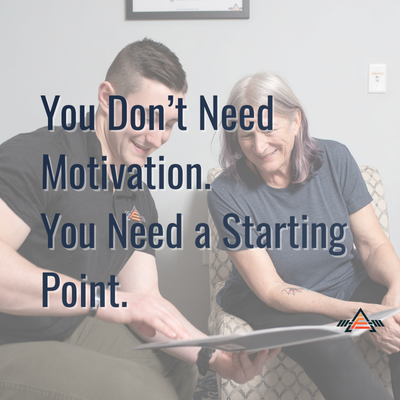
You don't need more willpower. You need the right environment.
Book a No Sweat Intro. We'll sit down, talk about where you are, and show you what a system built for real life actually looks like.
BOOK YOUR NO SWEAT INTRO
Why You Keep Starting Over: A 3-Part Series
Part 1: The Restart Trap
Part 2: It Was Never About Discipline // You are here
Part 3: The Space Between Who You Were and Who You Want to Be // Coming Soon

.jpg)


.jpg)
.jpg)
.jpg)
.jpg)

.jpg)

.jpg)
.jpg)
.jpg)

.jpg)
.png)
.jpg)
.png)
%20(1).jpg)
.jpg)

.png)
.png)



.png)
.png)


.png)


%20(Instagram%20Post).png)
.jpg)


.png)


.png)