Why We Add a Primer Before the Workout
The short, specific block that happens right before the scored effort is not conditioning. It is preparation.
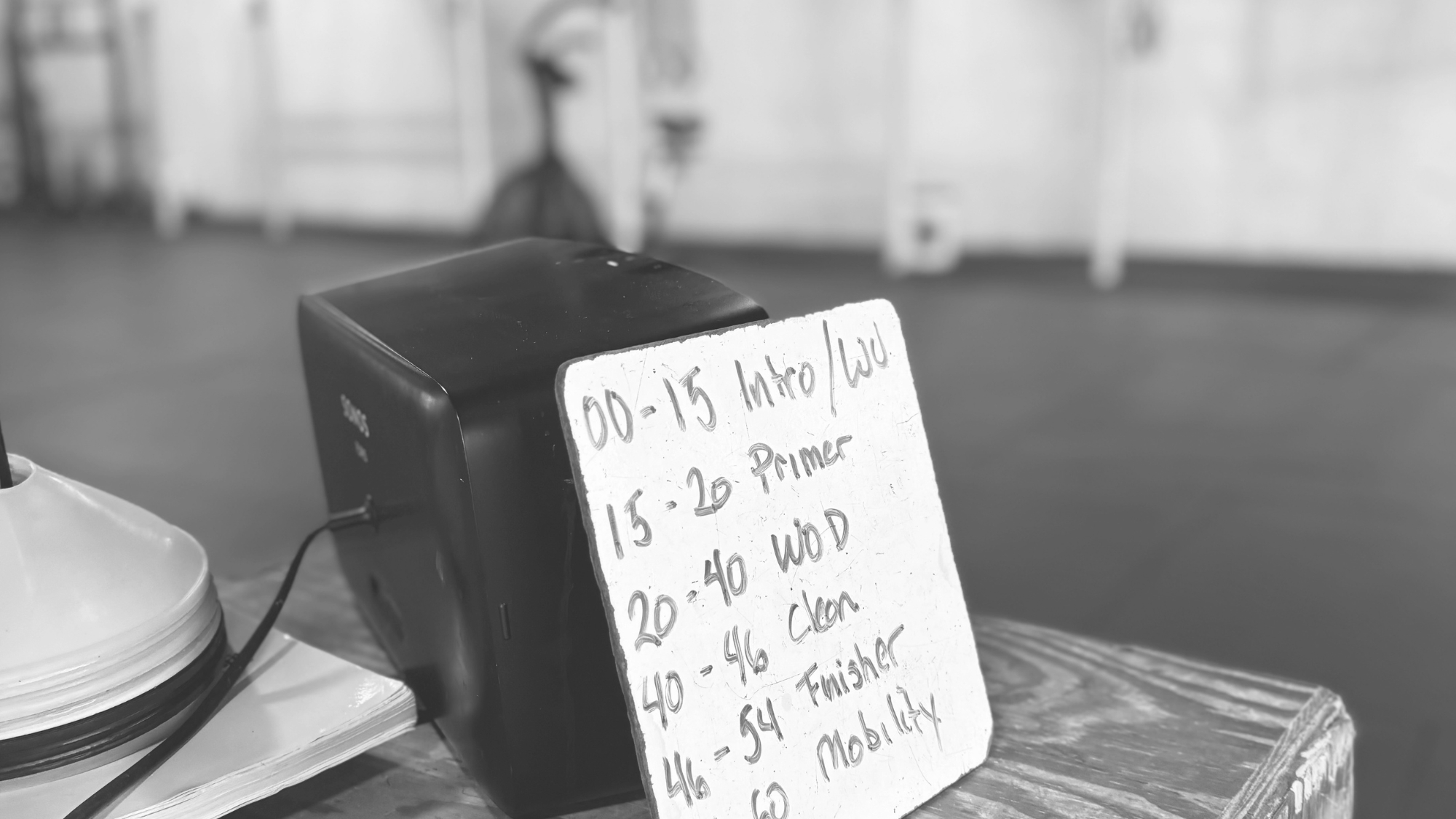
If you have been in class recently, you have noticed a small block of work sitting between the specific prep and the main piece. A couple of short sets at working pace. A taste of the movements. A breath, and then we go.
That block has a name. We call it a primer. It is not a bonus workout. It is not there to soften you up before the real thing. It is there to make sure that when the clock actually starts, you already know exactly what you are walking into.
This post explains what a primer is, what the research actually supports, and where a good primer ends and pointless pre-fatigue begins.
What a Primer Actually Is
A primer is a short, specific, low-fatigue rehearsal of the workout that is coming next. It uses the same movements, the same stations, and the same general pace you intend to hold during the scored effort, just at lower volume and with honest rest.
In practice, that usually looks like one or two sets through the exact movements of the workout, at working pace, with brief recovery between. Just enough to dial things in. Not enough to tax anyone.
That distinction matters. A primer is not a second warm-up and it is not a third workout. Researchers describe warm-ups as preparation for the demands of the task ahead, structured to raise readiness without creating fatigue (Fradkin et al., 2010). A primer is the most specific, closest-to-the-effort part of that preparation.
A primer is a rehearsal, not a test. If you are grinding during the primer, we have the dose wrong.
Why We Use It Before the Workout
A good primer does five things that a general warm-up by itself cannot do:
It locks in your output. There is a real difference between the pace you think you can hold and the pace you can actually hold once all the pieces of the workout are stacked together. The primer lets you feel that pace before it counts.
It confirms your scaling. What looks fine on paper can feel different in the second round. A primer set or two tells you whether your scale holds up under repeated exposure, not just on the first perfect rep.
It confirms your movement standards. Every standard is easier to hit fresh and harder to hit tired. Rehearsing the standards at working pace, before fatigue, means you know what the rep is supposed to feel like when the workout gets hard.
It sharpens your transitions. Moving from one station to the next. Where your water goes. Where your towel is. What your breathing feels like before you get to the next movement. Transitions are where most athletes leak time, and they are essentially free to practice.
It raises readiness. Specific, task-matched preparation tends to outperform generic preparation for power and speed work (Herrera & Osorio-Fuentealba, 2024). The primer is the part of the day that is most specific to what you are about to do.
What the Research Actually Says
The warm-up literature is broader and more nuanced than most people assume. Three findings are worth knowing.
Warm-ups reliably improve performance when they are task-specific. In a systematic review of 32 high-quality studies, Fradkin and colleagues found that "warm-up was shown to improve performance in 79% of the criterions examined" (Fradkin et al., 2010, p. 140). The warm-ups that did not improve performance tended to be the ones that were too generic, too short to raise muscle temperature, or poorly matched to the task (Fradkin et al., 2010).
Specificity and dose matter more than intensity. A recent review of warm-up methods concluded that an inappropriate warm-up can be counterproductive and that preparation should be individualized and specific to the task (Herrera & Osorio-Fuentealba, 2024). In plain English, more is not better. Better is better.
Stacking extra high-output work on top of a solid warm-up does not reliably add anything. This is the most important point. Rappelt and colleagues (2024) ran three separate studies testing whether heavy loaded work performed after a comprehensive warm-up could further boost jump performance. It could not. Their conclusion was direct: protocols designed to further potentiate performance "do not further improve jumping performance compared to a general and muscle-specific traditional warm-up" (Rappelt et al., 2024, p. 2).
That is the evidence behind why our primer is short and submaximal instead of long and hard. Once you have warmed up well and rehearsed the movements, adding more difficulty does not buy you more readiness. It just buys you fatigue.
How This Shows Up in High-Intensity Training
This approach is not new. In high-intensity and athletic settings, thoughtful coaches have long used a specific rehearsal block to bridge the gap between the general warm-up and the main effort. The word "primer" is not always on the whiteboard, but the logic is the same: the last block of work before the scored effort should mirror the demands of that effort, at a dose that sharpens readiness without stealing from performance.
That is what our primer is. The specific warm-up, done with enough intent to actually prepare you, and with enough restraint to leave you fresh for the scored effort.
The stretching and warm-up research in trained athletes backs this up from a different angle. Adding extra work to a standard warm-up, whether that is static stretching, ballistic stretching, or proprioceptive techniques, does not reliably improve jump, sprint, or kicking performance in trained athletes (Hernández-Martínez et al., 2023). A good warm-up does the work. What matters is that the last block before the effort is specific to the effort.
What a Good Primer Is Not
A good primer is not a second workout in disguise. If the primer leaves you breathing hard and waiting for your arms to come back, it was dosed wrong. The goal is readiness, not residue.
A good primer is not a maximal effort. The value of rehearsing at working pace is that you learn the pace. A max effort inside the primer teaches you something different, and it costs you output later.
A good primer is not a place to figure out your scale for the first time. The primer is where you confirm a scale you have already chosen, not where you audition three versions of a movement.
And a good primer is not long. A set or two. Brief rest. Clear intent. Done.
What to Do With This as a Member
When your coach calls the primer, treat it like dress rehearsal. Move at the pace you intend to hold. Use the scale you plan to use. Hit the standards you will be judged on. Practice the transition. Notice what your breathing feels like and notice how the movements feel stacked together.
Then rest. Take the brief break. Reset your station. And when the clock starts, you should not be guessing. You should already know.
That is the whole point. A well-designed primer does not ask more of you. It makes the ask of the workout clearer, so you can meet it with intention instead of guesswork.
Want to experience how we coach training sessions?
Book a No Sweat Intro and see what thoughtful class design feels like in person.
BOOK YOUR NO SWEAT INTRO
References
Fradkin, A. J., Zazryn, T. R., & Smoliga, J. M. (2010). Effects of warming-up on physical performance: A systematic review with meta-analysis. Journal of Strength and Conditioning Research, 24(1), 140–148. https://doi.org/10.1519/JSC.0b013e3181c643a0
Hernández-Martínez, J., Ramírez-Campillo, R., Vera-Assaoka, T., Castillo-Cerda, M. A., Carter-Thuillier, B., Herrera-Valenzuela, T., López-Fuenzalida, A., Nobari, H., & Valdés-Badilla, P. (2023). Warm-up stretching exercises and physical performance of youth soccer players. Frontiers in Physiology, 14, 1127669. https://doi.org/10.3389/fphys.2023.1127669
Herrera, E., & Osorio-Fuentealba, C. (2024). Impact of warm-up methods on strength-speed for sprinters in athletics: A mini review. Frontiers in Sports and Active Living, 6, 1360414. https://doi.org/10.3389/fspor.2024.1360414
Rappelt, L., Held, S., Wiedenmann, T., Micke, F., & Donath, L. (2024). Post-activation performance enhancement (PAPE) protocols do not further increase jumping performance beyond warm-up effects: Findings from three acute randomized crossover trials. Frontiers in Physiology, 15, 1447421. https://doi.org/10.3389/fphys.2024.1447421
.jpg)

.jpg)
.jpg)

.jpg)

.jpg)
.jpg)

.jpg)
.png)
.jpg)
.png)
%20(1).jpg)
.jpg)


.png)
.png)





.png)
.png)


.png)


%20(Instagram%20Post).png)
.jpg)


.png)


.png)