The Restart Trap | Why You Keep Starting Over Part 1
You don't have a discipline problem. You have a restart problem. Part 1 of our new series on why the cycle of starting over keeps you stuck, and what actually breaks it.
By
Austin Phillips, Founder of Ardent
March 29, 2026
Don’t miss another article
Thank you! Your submission has been received!
Oops! Something went wrong while submitting the form.
Something shifts. Maybe it's spring. Maybe it's a photo you didn't expect to see. Maybe it's just a quiet moment where you realize you don't feel like yourself anymore.
And the thought shows up: This time I'm going to do it. This time is different.
You sign up. You go hard. You meal prep on Sunday. You're all in.
And then, somewhere around week three or four, something cracks. The schedule gets tight. The soreness doesn't feel like progress anymore, it just feels like soreness. One missed day becomes two. Two becomes a week. And the voice in the back of your head says the thing it always says:
See? You can't stick with anything.
That voice is wrong. But I understand why you believe it. Because the fitness industry has been feeding that voice for decades.
The Day 1 Problem
Scroll through any fitness page on social media and you'll see it. "Day 1." Sometimes with a fire emoji. Sometimes with a before photo. Always with the same energy: I'm starting from scratch and this time it's going to stick.
It sounds empowering. It feels like a clean slate. And the fitness industry loves it, because "Day 1" sells programs. It sells challenges. It sells the idea that all you need is a new beginning and enough willpower to white-knuckle your way through it.
But here's what nobody tells you about "Day 1."
Every time you restart, you're not just beginning a new program. You're reinforcing a story about yourself. The story that says: I'm someone who starts things and doesn't finish them.
That story gets heavier every time. And the next "Day 1" has to carry all that weight.
"Every time you restart, you're not just beginning a new program. You're reinforcing a story about yourself."
The restart cycle isn't a motivation problem. It's an identity problem. And it doesn't get solved by a new app, a new challenge, or a new "accountability partner" you met on the internet.
It gets solved by understanding why the cycle exists in the first place.
I've Been There
I want to be honest with you about something, because I think it matters.
I've owned Ardent for almost twelve years. I've coached thousands of people. I've built programs, written curricula, studied behavior change at the graduate level. And in that time, I have fallen off. More than once.
There have been stretches where my own training slipped. Where the stress of running a business, navigating life, and carrying other people's goals left me with nothing in the tank for my own. Where I looked up and realized I wasn't practicing what I was preaching.
And every single time, the hardest part wasn't the workout. It was walking back in. It was sitting with the gap between where I was and where I used to be. That gap is humbling. Sometimes it's embarrassing. And if you let it, it'll keep you on the sideline longer than anything else.
I'm not telling you this so you feel better about me. I'm telling you because I need you to understand that progress is never linear. Not for you. Not for the person next to you in class. Not for the person who owns the gym.
Results, effort, consistency. None of it is a straight line. It's messy. It dips. It stalls. But you can still keep an upward trajectory over time if you do one thing:
Show up.
The Difference Between Restarting and Returning
This is the part most people miss, and it changes everything once you see it.
Restarting says: I failed. That version of me is gone. I need to begin again from zero.
Returning says: I stepped away. I'm not where I was. But I'm not starting from nothing, either.
That distinction matters more than any workout program ever will.
When you restart, you erase your own history. All the reps, all the early mornings, all the hard weeks you pushed through before life got in the way. You throw all of that out and tell yourself you're back at square one. And that's a lie. A cruel one.
When you return, you carry that history with you. You're different now, sure. Maybe your body has changed. Maybe your capacity has shifted. But the person who built that foundation is still in there. The knowledge is still in there. The part of you that chose to do hard things, that's still in there too.
Returning is not failure. Returning is one of the bravest things a person can do.
"The first step is the hardest, so they say. But sometimes, the hardest thing is the first few steps forward after taking a few steps backwards."
What We've Watched Happen
In almost twelve years of running Ardent, I've seen this pattern play out hundreds of times. People leave for real reasons. They move away and move back. They have a baby. They go through a divorce, a job change, a health scare. They just drift, slowly, the way most people do when life fills up every available space.
And then there was COVID.
Our gym stayed open. We adapted, adjusted, kept showing up. But a lot of people left anyway. Not because they didn't care. Because everything was uncertain and scary and the world felt like it was coming apart. That's a valid reason to pull back. Nobody should feel guilty about surviving the way they needed to survive.
But here's what happened after. People wanted to come back. Some did, quickly. Others took months. Some took years. We still have people finding their way back right now, in 2026, from a disruption that started six years ago.
And the thing that slows them down the most? It's not fitness. It's not money. It's not their schedule.
It's the feeling that they've changed. That they're not who they were when they left. That the person who used to deadlift or run or show up three times a week doesn't exist anymore. And walking into a place that knew that version of them feels exposing.
I get it. Truly. That feeling is real and it's heavy.
But I want you to know what happens when people actually walk back through the door.
What Coming Back Actually Looks Like
Nobody gets thrown back into the deep end. That's not how this works.
When someone comes back to Ardent after time away, the first thing we do is sit down and talk. Not about reps or programs. About life. What happened. Where they are now. What's different. What they're hoping for.
Then we adjust. Our programming is prescriptive. That means it's designed to meet you where you are, not where you were. Whether you've been gone for three months or three years, the program moves with you. Even our group classes are built this way. You're not behind. You're just in a different spot, and the program accounts for that.
Nobody looks at you sideways. Nobody asks where you've been with judgment in their voice. Because everyone in that room has been through something. Everyone has had a season where life won and the gym lost. That's not weakness. That's being human.
The empathy in that room is real because every person in it has earned it the hard way.
"Welcome back. We got you. Just show up."
Why This Keeps Happening
If you've been caught in the restart cycle, I want you to hear this clearly: it is not because you lack discipline.
Most people who restart and quit, restart and quit, restart and quit are doing so because they were set up to fail from the beginning. The program was too aggressive. The environment didn't support them. There was no one checking in. There was no plan for when life got hard, only a plan for when things were perfect. And things are never perfect.
The fitness industry makes money when you restart. Think about that. Every "New Year, New You" campaign, every 6-week challenge, every "transformation" program is built on the assumption that you'll need to come back and buy it again. The cycle isn't a bug. It's the business model.
What breaks the cycle is not more motivation. It's a system that's designed to absorb the dips. A place that expects you to have hard weeks and doesn't treat a missed session like a moral failure. Coaches who know your name and notice when you're gone. A program that adjusts when your life adjusts, instead of demanding that your life bend around it.
That's not a fantasy. That's how we built this place. On purpose.
You Don't Need a Fresh Start
If you're reading this and you're in that space right now, the space where you know something needs to change but you're tired of trying, I want you to sit with something for a minute.
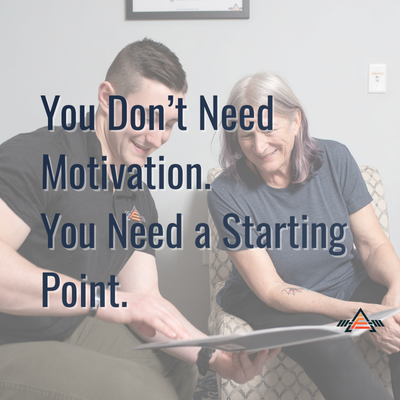
You don't need a fresh start. You need a place that will let you come back without making you feel like you have to earn your way in again.
You don't need Day 1. You need someone to say "welcome back" and mean it.
You don't need to be who you were. You need a program that meets you as you are, right now, today, with everything you're carrying.
That's not a pitch. That's a promise. And it's one we've been keeping for nearly twelve years.
In Part 2, we're going deeper. We're going to talk about the myth of discipline, and why the thing you think is holding you back has almost nothing to do with willpower. But for now, I'll leave you with this:
You're not starting over. You're picking up where you left off. And that's a very different thing.
Ready to come back? Or ready to walk in for the first time?
Book a No Sweat Intro. It's a 20-minute conversation. No workout. No pressure. Just a real talk about where you are and how we can help.
.jpg)


.jpg)
.jpg)
.jpg)
.jpg)
.jpg)

.jpg)

.jpg)
.jpg)

.jpg)
.png)
.jpg)
.png)
%20(1).jpg)
.jpg)

.png)
.png)



.png)
.png)


.png)


%20(Instagram%20Post).png)
.jpg)


.png)


.png)