Weights and Balances • Part Two of Three
Whose Best Life Are You Living?
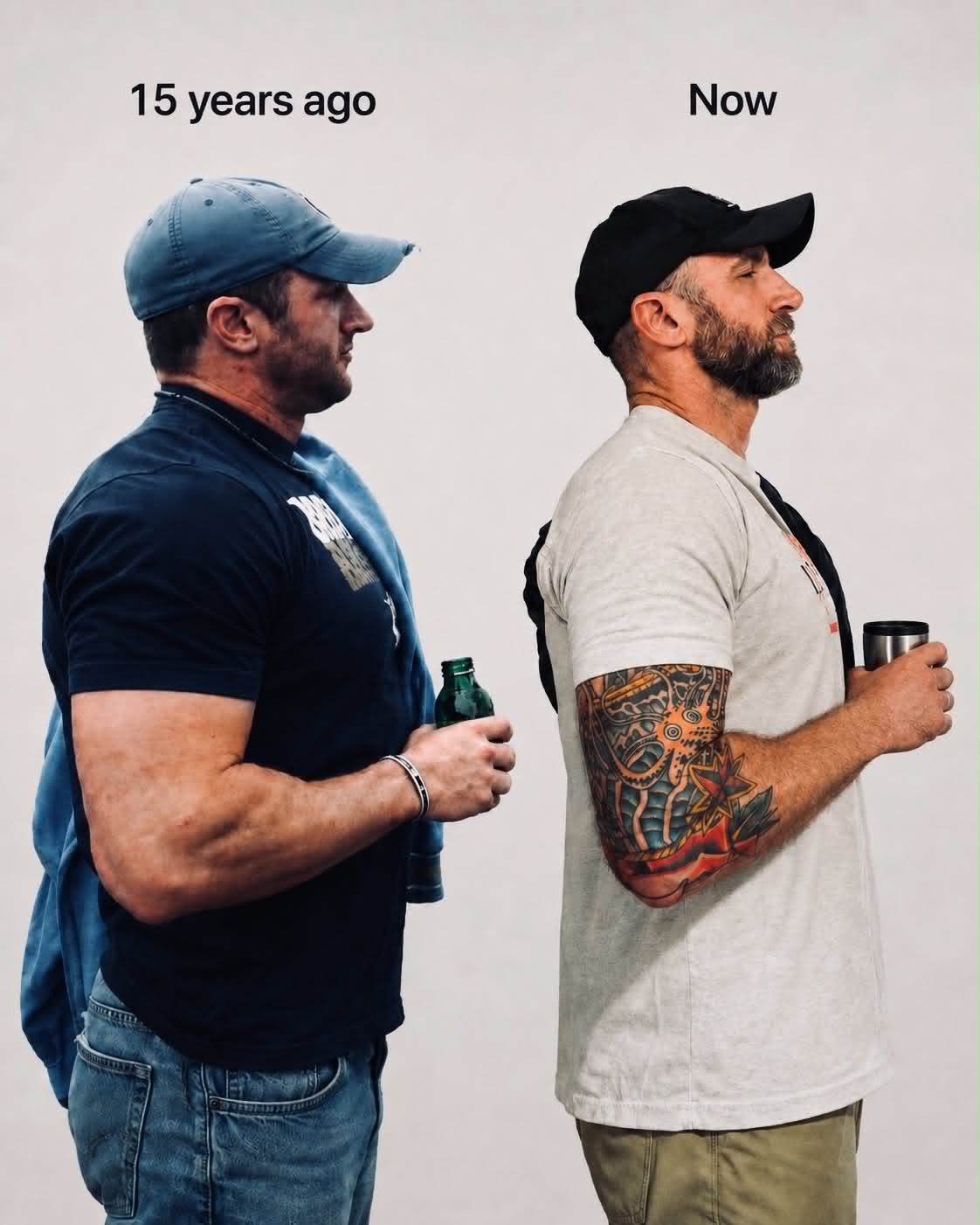
This is me, exactly fifteen years apart. Same guy, two completely different scales.
The guy on the left is bigger and stronger in a few lifts. Beer in hand. By most of the metrics I cared about back then, he is the fitter one. More weight on the bar, a 405 bench, more size, more of whatever I thought I was supposed to be doing or chasing. The guy on the right is leaner, holding a coffee, and a lot more at home in his own skin.
Here is the question I want to pose, because it is the whole point of this segment. Which one is healthier? It is a trap. (Imagine that meme with Admiral Ackbar.) It is the wrong question. Both of those guys were fine. The honest difference is not the body. It is that only one of them was actually aiming at my life, living his best life.
Marcus Aurelius kept a private journal that we still read two thousand years later, mostly notes to himself about how to not lose the plot. I am not promoting Stoicism, there are areas I agree with and areas I do not, and it is not the point of this post. One thing he discussed, and an area I align with, is this. We love ourselves more than we love anyone else, and yet we trust everyone else's opinion of us more than our own.
This dude was running an empire and still had to remind himself to stop outsourcing his opinion to others. Think about your life and think about where you may have outsourced your opinion of yourself. I am sure you have, I know I have. The fifteen-years-ago version of me had not figured that out yet. I was partly training for a version of myself that was never mine to begin with.
There is a phrase for what I feel looking at the younger one now. It is amor fati, love of fate. Not gritting your teeth and tolerating the path you took, but actually wanting it, the detours, wrong roads, and the dumb decisions included. I do not look at that guy and cringe. I needed him. He carried me here, on his back, over the bumps and wrong turns. You do not get the version on the right without the version on the left, so I am not about to disown him, even though he would cringe at my bloviated language and lack of bar time escapades.
Which brings us back to the only thing that actually matters in that photo. Whose best life is each of them living? And that depends entirely on whose goals you are measuring against.
In part one, we threw out the idea of perfection. You are already somewhere on the health spectrum, and the only real question is which way you are tilting. We swapped good and bad for better words.
Aligned with your goals, or misaligned with them.
Which leaves one small word doing a lot of work in that sentence. Yours. Aligned with whose goals?
The scale is not one scale
How you train, sleep, eat, handle stress, and the people you spend your time around impact your wellness. Each is its own balance, and with aligned choices on one side and misaligned choices on the other side.
These scales are connected, and in the study of wellness it is described as multidimensional, meaning that each part of your health strengthens or weakens the others (think of our Liminal Health Survey). Think back to a time where you had a week of bad sleep and how that makes food harder, makes training feel flat, and makes the people you love a little more irritating than they truly are. If you are a parent, remember the early years, maybe some sleep regression (I know a few of you are going through that right now).
So when someone pushes a plan that touches only one of those on its own, be a little skeptical unless you are speaking to a specialist to impact one definitive portion of your life. Look at yourself like a system, and systems do not respond well to advice aimed at a single part of the whole.
Your body keeps score
There is a version of this scale running inside you regardless of your feelings on this matter.
Your body is built to handle stress in the moment, this is how we evolved and out survived other bipedal sapiens. Heart rate up, focus sharp, energy where you need it, then back to baseline once the pressure passes. (I also think the poor vision of Neanderthals in low light played a role, but that is a me theory.) This is called allostasis, essentially staying stable by changing. Issues start when the stress never fully switches off. That shit piles up when the system runs hot for too long, the allostatic load. You have negative outcomes, and you can see this in the veteran population, especially post deployment.
Hard training, poor sleep, work pressure, skipped or crappy meals, and always being reachable all land on one side. Real recovery, good food, sleep, movement you enjoy, and time with people who fill you back up land on the other. Your body does not moralize any of it. It does not care whether a stressor came from a bad decision or a hard season of your life. It adds up the load and subtracts the recovery despite how much you try and reason with it. I can attest to this on a personal level. I have had a tough last few years and I am just starting to feel "normal" again. I tried, for a long time, to logically justify how I felt. It didn't work, the scale kept sliding in the wrong direction. It wasn't until I started focusing on the small parts did the scale start tipping in the right direction, and I am feeling better than I have in a long time.
Your body does not keep a moral scorecard. It keeps a balance. Load on one side, recovery on the other.
This is the same lesson from part one, now written in your physiology. The goal was never a clean record. The goal is to keep recovery outweighing load, as much as possible over time. The tab you may have developed is not forever, it can be changed. When you change the inputs, the number moves. You are never stuck where you are on the spectrum. No matter where you are, if you are not dead, you can move that number.
Whose goals, though?
Yours. It has to be your goal. If it is not, then you are not going to be invested.
Open your phone and you will find an endless supply of people prescribing their life onto yours. Their body, their split, their macros, their five in the morning routine. The feed is very good at this, because it is built to be. It is designed to keep you watching and keep you comparing, which is a strange foundation to build your health on. Delete your social apps. I am f*cking serious. Or at the very least, turn off notifications. Your life will become better if you add some friction.
Psychologists separate the motivation that comes from outside you, doing something for a reward, a look, or other people's approval, from the motivation that comes from inside, doing something because it genuinely fits your own values and life. Edward Deci and Richard Ryan, who pioneered self determination theory, describe it best. The outside kind is fragile. It fades when the likes stop or the novelty wears off. The inside kind lasts.
That is why copying someone else's best life almost never works. It was never your motivation. It was theirs, borrowed, and borrowed motivation has a short shelf life. The second you outsource to the crowd, you are living for a verdict that is not even yours.
This is why we prescribe
The opposite of an influencer telling you what to do is not nobody telling you anything. It is guidance built around you instead of borrowed or on loan from someone else.
What does good guidance actually need? Three things. A real say in the plan, so it feels like yours and not a sentence handed down to you. A plan calibrated so you can actually pull it off and feel yourself getting better. And not having to do it alone.
Choice, capability, and connection. See the Ardent Way. It is built into the framework.
When a plan has all three, the motivation is intrinsic, which is the only place motivation will work for the long run.
The medical consensus on health and nutrition is that no single approach is best for everyone, and that people respond very differently from one another. So a prescription that ignores who you are, what your week looks like, what your body does, and who is at your dinner table is not really a prescription. It is a guess delivered with confidence, which we are prone to see as expert advice. This is also a problem with AI. It will tell you something in full confidence, wrong or otherwise. We are hardwired to view confidence as knowledge, but really most of it comes from the peak of Mount Stupid (Dunning-Kruger).
An influencer prescribes their life onto you. A coach prescribes your life back to you.
Well, now what the F are you supposed to do?
Your health is not one scale, it is several, and they are connected, regardless of what you think. Your body is already keeping a tab, totaling load against recovery with zero interest in your guilt or whatever fallacy you have bobbling around between your ears. And the goals on that scale have to be yours, because anybody else's will not last.
Look back at that photo one more time. The guy on the right did not get there by copying anyone. He got there by slowly figuring out which scales were actually his, and tilting those. None of it asked for an overhaul. It asked for small, aligned inputs that fit the life I was actually living. That is part three. How to tip these scales this week, in the time you have, without the plan eating your whole calendar.
To be fair, I would have arrived at my current state years earlier if I had this knowledge. I have fallen into the trap of listening to how others lived their best lives and tried to immerse myself in their method. Remember, you are the sum of your decisions, good and bad. I wouldn't be typing this if I hadn't made some wrong decisions, and holy crap I have made some bad ones. I listened to people who had their own best interests disguised as mine, in business, exercise, and life. I always try to remember not to hold it against them, because no one is the villain in their own story, but we are all the villain in someone else's.
I want the gym to support your life, not your life to support the gym.
Not sure which of your scales to tip first, or whether the plan you are following was ever built for you in the first place? That is what a No Sweat Intro is for. We look at your actual life, then build from there.
Book a No Sweat Intro
Prefer to keep it simple? Reply BALANCE and we will set up a time. No pressure and no sweat.
Sources
On living for your own judgment instead of the crowd's, and on amor fati: Marcus Aurelius, Meditations, and Friedrich Nietzsche, whose phrase amor fati appears in The Gay Science and Ecce Homo. Both are old, both are public domain.
Allostatic load, the cumulative wear and tear of chronic stress, and allostasis, stability through change: McEwen and Stellar, 1993. Overview: sciencedirect.com/topics/neuroscience/allostatic-load.
Inside versus outside motivation, and the three needs behind durable change: Ryan and Deci, Self-Determination Theory and the Facilitation of Intrinsic Motivation, American Psychologist, 2000: selfdeterminationtheory.org/SDT/documents/2000_RyanDeci_SDT.pdf.
Wellness as multidimensional, with each dimension strengthening or weakening the others: framing from the Global Wellness Institute, building on Antonovsky's salutogenic model from part one.
No single approach is best for everyone, and responses vary person to person: the principles of obesity summarized by the International Obesity Collaborative.
.jpg)

.jpg)
.jpg)
.jpg)

.jpg)

.jpg)
.jpg)
.jpg)

.jpg)
.png)
.jpg)
.png)
%20(1).jpg)
.jpg)

.png)
.png)



.png)
.png)


.png)


%20(Instagram%20Post).png)
.jpg)


.png)

.png)